Silicon photonics procurement
Silicon Photonics Packaging: Bounded Service Quote or Development Project? A Pre-RFQ Scope Test
Atom Industries proposes a pre-RFQ scope test for silicon photonics packaging requests: separate a bounded contract-manufacturing quote from a development or transfer project by fixing the deliverable, PDK scope, acceptance terms and agreement prerequisites, using provider statements from PHIX, AIM Photonics, SMART Photonics and GlobalFoundries.
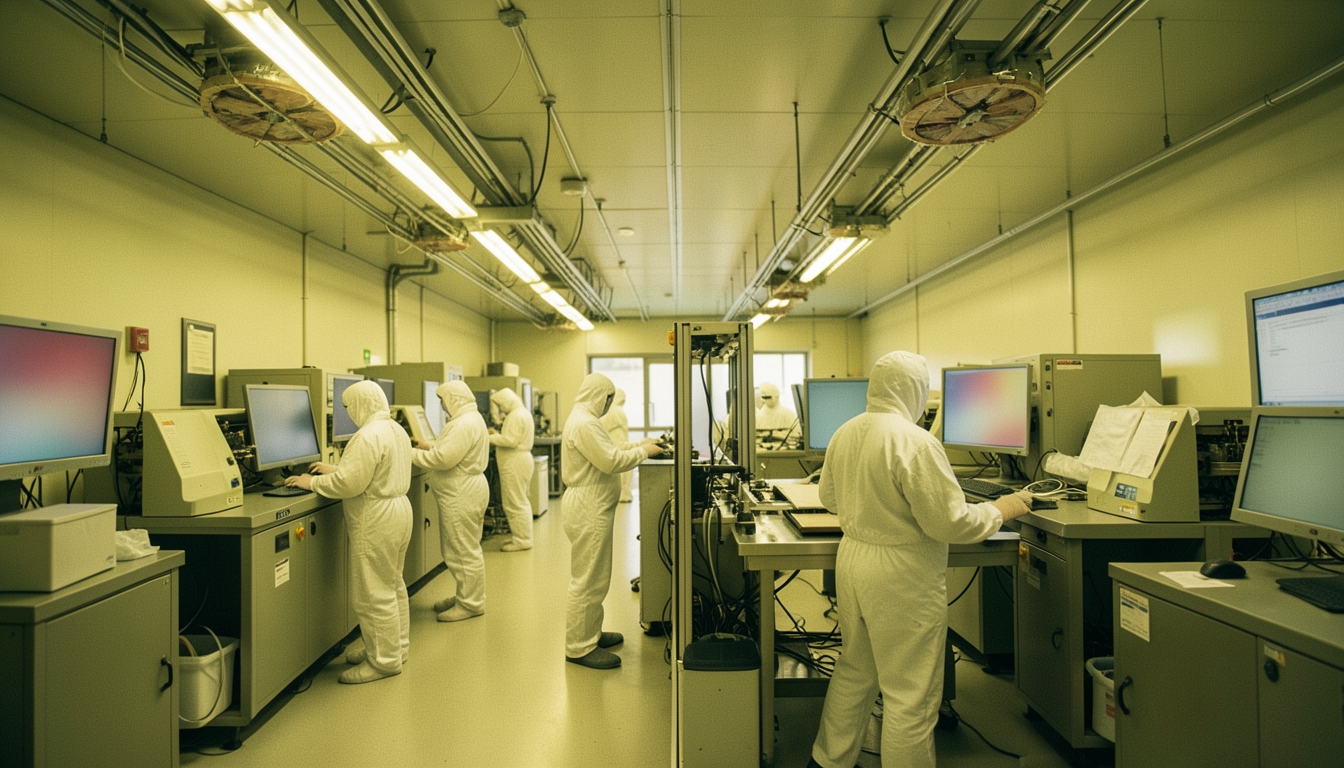
The decision a packaging request forces
When a customer asks for silicon photonics packaging, first record the deliverable boundary: substrate, fabricated die, assembled module, or test service, and who accepts each one. Atom Industries proposes, as a scoping test rather than a sourced or industry-standard rule, that a request fits a bounded contract-manufacturing quote when the design is fixed to a specific process design kit revision and the deliverable and acceptance test are defined, while a request for PDK changes or transfer of process ownership should be handled as a development or transfer project.
The provider statements below give the basis for this test and its limits.
Where the service boundary sits
PHIX, a provider of assembly services and contract manufacturing for photonic integrated circuits and MEMS, states that a photonic integrated circuit by itself is not a functional product: to become part of a photonics-enabled module it must be connected to optical fibers, other PICs, cooling solutions, and electronics. PHIX describes photonic IC packaging as a micro-assembly process that also involves thermal management and the connection of optical fibers and electronics, producing a module with optical and electrical inputs and outputs, and calls itself the photonic equivalent of an OSAT, an outsourced semiconductor assembly and test company.
That definition complicates any simple service-versus-development split. PHIX states that going from a PIC to a functional module is a multi-disciplinary design process involving product design of the chip and the module, assembly process development, and equipment management, and that it can produce working prototypes from the first chips and then optimize the PIC and module design, process, and equipment to scale production to high volumes. PHIX presents assembly process development as part of its service, not separate from it. Our inference, labeled as ours, is that a module-level packaging service and a wafer-foundry service are different purchases: PHIX describes assembly from a PIC to a module, while the wafer providers below describe PDK-based wafer production. Record which of the two, or both, the request covers, and do not assume that any process development in the request automatically moves it out of a service quote.
Agreement prerequisites before an RFQ
AIM Photonics, a US photonics manufacturing institute, publishes its prerequisites for purchasing wafer fabrication or test, assembly and packaging services. Because such purchases involve disclosure of confidential information, AIM states the first step is an agreement covering the terms of that disclosure: members are already covered by their membership agreement, and non-members must have an executed non-disclosure agreement signed by both parties. AIM then requires a services agreement setting the terms and conditions for payment and delivery of hardware, and states that the fully executed services agreement is required before it can reserve space on a multi-project wafer run or a private run, or provide test, assembly and packaging services. AIM also requires an export control form to meet US export control regulations, and notes that its agreements are executed through the Research Foundation for the State University of New York.
These are one provider's stated steps, but they give a useful template. A proposed diligence step from Atom Industries for any packaging or foundry RFQ: confirm in writing which confidentiality instrument applies, whether the services agreement must be executed before capacity is reserved, and, where US export control regulations are in play, which filings the transaction triggers. Whether providers outside the US impose comparable export-control steps is not addressed by these sources and should be checked with each provider directly.
Fix the PDK scope before quoting
SMART Photonics, a pure-play manufacturer in Eindhoven, presents its production path as three steps: design with a process design kit, then alpha production, then volume production. SMART states it supports customers from proof of concept to high volume production and offers the complete production process of photonic integrated circuits from epitaxial growth and re-growth, processing, polishing and more. SMART's own published customer questions show the scope questions a buyer must settle: delivered MPW chip thickness, whether an O-band MPW platform exists, which other wavelengths are supported, whether building blocks not in the PDK are available, and whether a high-speed platform exists. The conclusion that PDK scope must be fixed before a quote is our inference from these questions, not a statement by SMART; a customer needing a building block outside the PDK should confirm with the provider whether that falls inside or outside a standard service before assuming either.
GlobalFoundries' announcement of November 17, 2025, describing its acquisition of Advanced Micro Foundry, a silicon photonics foundry based in Singapore, states that AMF offers manufacturing, prototyping and testing services supported by proprietary technology platforms and process design kits designed in-house. The same announcement states that GF will address demands on AMF's 200mm platform in Singapore with plans to scale to 300mm as market needs grow. The 200mm statement describes a platform; the 300mm statement is a plan, and a buyer should treat it as forward-looking rather than as capacity on offer today.
Announced capacity is not current capacity
Two capacity statements in the sources are explicitly forward-looking. SMART Photonics states it is investing in new 6-inch indium phosphide wafer production capacity and that, when fully activated in 2028, the new production is expected to manufacture more than 12,000 wafers per year. GlobalFoundries states its acquisition will expand its silicon photonics technology portfolio, production capacity and research and development in Singapore, and that it plans to establish a silicon photonics research and development center of excellence in Singapore partnering with A*STAR, focused on next-generation materials for ultra-fast data transfer at 400Gbps speed. These are supplier announcements and plans, not independent proof of performance and not a commitment of capacity to any specific customer. As a proposed diligence step, ask any provider for current run schedules and expected volume by quarter rather than relying on announced expansions; whether providers publish run schedules is not addressed by these sources.
Checklist before quoting
This checklist is an Atom Industries proposal, not a provider's published process. Confirm the item being purchased: substrate, fabricated die, assembled module, or test service. Identify who accepts each deliverable and against what test. Record the PDK or process revision the design is fixed to, and whether the customer expects building blocks or process steps outside it; confirm with the provider whether those fall inside the standard service. Confirm the confidentiality instrument, the services agreement status, and export-control requirements where US regulations apply. Ask for current run schedules and volume by quarter. Note whether the customer expects transfer of process ownership, which the proposed test above treats as moving the request out of a standard service quote.
What the sources do not answer about process licences
The comparison a buyer might search for, a process licence versus a foundry service agreement, cannot be completed from these sources. None of the provider pages describes licence terms, royalties, field-of-use restrictions, or technology-transfer obligations; they describe PDK access, wafer runs, packaging services, and service-agreement prerequisites. The silence of these excerpts is not evidence that process licences are unavailable or uncommon. Treat licence-specific terms as open diligence questions to raise directly with providers under an NDA, not as conclusions of this article. Atom Industries is development-stage and has no manufacturing capacity to offer today; we are researching how a documented requirement could match an experienced operator, and this scoping test is the contribution we can make before any such match exists.
The next question to ask the customer
As Atom Industries' proposed starting questions, before either a service quote or a process-transfer discussion begins, ask the customer three things: which party owns the PIC design, which PDK or process revision is fixed, and what acceptance test defines a conforming module. The answers determine, under the proposed test above, whether the request is a bounded service or a development project, and they give an operator the minimum nonconfidential scope needed to start a qualification discussion.
Sources & further reading
This perspective supports research and relationship development. It does not represent available manufacturing capacity, a committed transaction or an investment offering.