Data-center site selection
A dated grid connection before a lower power price: the tenant's evidence file for Latin America AI data-center site offers
Advance a Latin America AI data-center site only if its offer contains dated evidence that the interconnection can be energized by your required date. This article sets out the evidence to demand before you rank offers on power price.
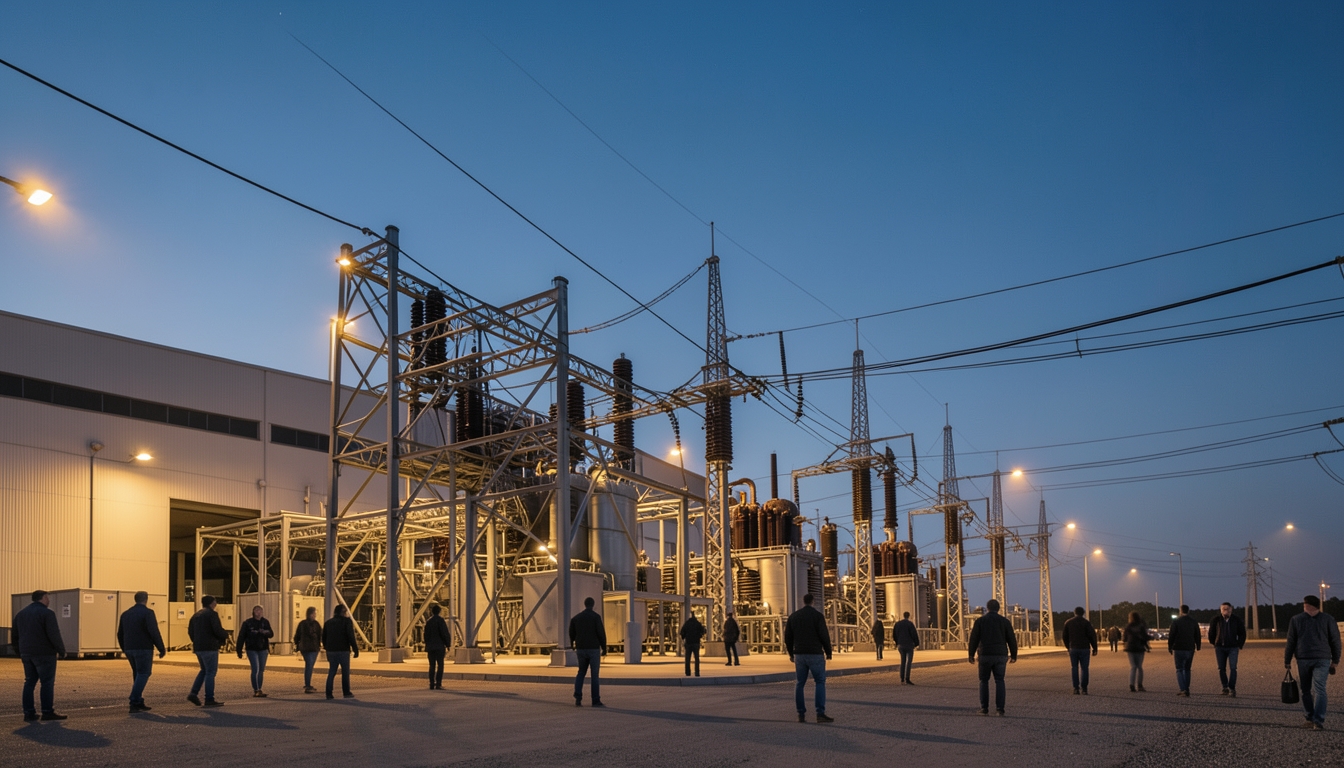
The decision: gate on the connection date, then compare price
Advance the site only if the offer contains dated evidence that the interconnection can deliver firm power by your required energization date, or a bridge you are prepared to accept. A lower power price on a site whose connection slips past that date is a price for power you cannot yet use. This is a proposed diligence sequence, not a sourced finding: verify the evidenced connection date first, then compare price among the sites that pass that gate.
Why available electricity is not usable capacity
Xataka México, reporting on Querétaro, explains the distinction that decides this question: that electricity exists in a region does not mean a new installation can connect. Lines, substations and equipment are also needed to carry the energy to the data center, transform it to the required voltage and keep supply stable. A substation does not generate or store energy; it changes voltage levels and connects parts of the grid. A building can be finished, the servers installed and capital spent, and the site still cannot operate because the connection is not there. The same article quotes Guillermo García Alcocer, former president of Mexico's Energy Regulatory Commission, saying some data centers already built in Querétaro had waited up to two years to connect. That is one official's account of some sites, not a median wait, and it does not establish that every Querétaro project waited.
The International Energy Agency's Energy and AI report, published April 2025, frames the timing mismatch: a data center can be operational in two to three years, while the broader energy system requires longer lead times to schedule and build infrastructure, often with extensive planning, long build times and high upfront investment. The report's executive summary adds scale: a typical AI-focused data center consumes as much electricity as 100,000 households, and the largest ones under construction will consume 20 times that. Data centers accounted for around 1.5 percent of world electricity consumption in 2024, about 415 TWh, and the IEA's Base Case projects around 945 TWh by 2030.
What the Colón case shows about generators as a bridge
Rest of World reported that a Microsoft data center in Colón, Querétaro, was unable to plug into the energy grid and ran on gas-powered generators for at least part of the year. In 2023 filings to Mexico's environmental secretariat, Microsoft said the grid would not be fully operative to the company until mid-2027, citing long construction times required in its contract with CFE, the Federal Electricity Commission. The secretariat later approved Microsoft's request to use seven generators to temporarily power the facility. According to the filings, the generators would provide 70 percent of the data center's energy requirement for 12 hours per day between February and July 2025; the data center began operating in early 2024, and Rest of World states it is not clear how the site was powered before or after that period, or what its expected capacity is. Xataka México makes the structural point: UPS systems, batteries and backup generators respond to outages, and backup can buy time, but it does not replace the permanent grid connection a data center relies on every day.
The lesson for a tenant is a proposed one: when an offer presents backup generation, ask whether it is a temporary bridge with a dated end, tied to interconnection milestones, or an intended operating mode. Rest of World also cites the Mexican Institute for Competitiveness on a grid deficit of 48,000 megawatt-hours by 2030, more than half the country's 2023 output, which is context for how much new connection infrastructure the market requires.
The evidence file to require from each offer
This is Atom's proposed checklist, drawn from the reporting above rather than a sourced standard. For each offer, require: the interconnection agreement or equivalent with the utility or grid operator, with dated milestones for any required line and substation work; the permit status of that work with the permitting authority; the landowner's or operator's confirmation of land control for the connection route; a plain statement of whether backup generation is a bridge or an operating mode, and its fuel and emissions consequences; and contract remedies, milestone notices and conditions precedent tied to the energization date. Compare that evidenced date with your required energization date before you rank offers on power price. The cited sources do not provide tariff comparisons or a quantified price-versus-date tradeoff, so the weighting between a cheaper tariff and a credible earlier date is yours to set, and it depends on how much schedule flexibility your workload has.
Separate announced capacity from evidenced capacity. Xataka México reports that CloudHQ announced a 4.8 billion dollar investment for a six-data-center campus in Querétaro with up to 900 megawatts of critical IT load when fully developed, a planned substation of up to 900 MW and a 400 kilovolt transmission connection. Those are announced plans for connection infrastructure, not proof that the connection is built or energized. The same article reports, via MEXDC as relayed by Diario Rotativo in May 2026, that Querétaro concentrated 72 percent of Mexico's 279 MW of installed data-center capacity, with about 10 centers installed and 12 projects in development.
A national plan is not a connection date
Cuatrecasas reports that Chile's government presented the National Data Center Plan 2024-2030, PDATA, on December 5, 2024, led by the Ministry of Science, Technology, Knowledge and Innovation. The plan contemplates a critical-permits guide, an environmental evaluation criteria guide, and a digital tool intended to integrate information on energy availability, land use, connectivity and socio-environmental variables to identify strategic areas. A tenant should ask whether those guides and the tool are published and operative for a specific site, and should not treat a plan announcement as a site-specific connection date. The Cuatrecasas article describes the plan's objectives; it does not show that any Chilean site has a firm connection date as a result.
What would change the answer
The answer changes if the offer contains an executed interconnection agreement with milestones that predate your required energization date, or a bridge whose cost, duration and remedies you accept and your lender accepts. It also changes if your own schedule is flexible enough that a later connection is tolerable. Atom's analysis, not a sourced fact, is this: powered land is common, while a site that meets a tenant's full specification in the market the tenant wants, with the anchor contract in hand, is scarce, and the anchor tenant's credit quality on a long-term take-or-pay contract decides whether the project can be financed. A cheap tariff on a site that cannot energize does not change that.
Atom Industries' position
Atom Industries is a development-stage company planning AI data-center sites in Latin America, with candidate markets under study including Panama, Mexico, Central America and the Caribbean, and Brazil. Its stated approach is to assemble firm power, a permitted site and a signed anchor customer with strong credit before construction, so an experienced operator can build and run the facility; customers bring their own hardware. Atom Industries has no site, no power contract, no customer, no selected operator and no commitments of any kind today. The next question worth asking of any offer is simple: what document, dated and signed, proves the interconnection will be energized by the date you need?
Sources & further reading
- México está construyendo centros de datos para la IA. Algunos llevan dos años esperando poder encenderlos (Xataka México)
- Rising AI demand is outpacing energy supply worldwide - Rest of World
- Energy demand from AI - Energy and AI - IEA
- Executive summary - Energy and AI - IEA
- Nuevo plan estratégico para impulsar la industria de data centers en Chile (Cuatrecasas)
This perspective supports research and relationship development. It does not represent available manufacturing capacity, a committed transaction or an investment offering.